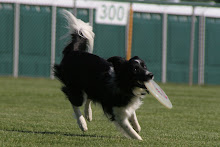
Today, Jun was discharged from Dr. Duxbury's care back to our regular vet. Dr. D is quite pleased with her progress, and to be honest, so am I. While the progress was excruciatingly slow and there is still work to be done, looking back at where we were when we started this behavior modification journey two years ago, it is clear how far we both have come.
Take as an example, her behavior at her first exam compared with today's. Two years ago I brought a very unhappy and perpetually stressed dog for her first appointment with Dr. Reichl. Though she was terribly afraid of Dr. R she pulled at her leash to go investigate and when Dr. R moved a finger, Jun snapped at her hand before running back to me, tail between her legs and ears low. She was hypervigilant and unfocused and fidgety.
Today, I brought a happy, calm dog with relaxed body language into Dr. D's office. She was mildly concerned about Dana, the assistant, but other than a brief stare, she felt no need to interact, kept her leash loose, and kept her attention on me. She offered looks at Dana for treats, comfortable with the rule structure of "new people" and trusting me to keep her safe. After a minute or two she laid on her mat, flopped on a hip with a loose body and soft eyes and mouth. She kept her attention 100% focused on me, glancing at Dana obligingly when cued, for no other reason than it would earn her a treat. When Dr. D came into the room, Jun looked, as cued, and stared a moment. After a couple of stares to satisfy her that there was no danger she went right back to relaxing. When she got bored she picked up her mat and offered it to me to play tug with. She was relaxed, happy, and playful, even in the presence of two strangers. Yep, we've come a long way.
Dr. Duxbury asked what I believed made the biggest difference in her transformation. The medication has clearly helped. Trazodone takes the edge off of her general anxiety. Clomipramine, while not eliminating her fear, has allowed her to learn ways to cope with it, such as the "look at that" game. But the thing that made the biggest difference, without a doubt, was my adjustment of my expectations.
I have high expectations. Of myself. Of others. Of my dogs. Of who they will be and what they will become and accomplish. Yet slowly, each in their own way, they have taught me that they are who they are and not necessarily who I want them to be or who I think they should be. And the more I fight to mold them to my ideals the more damage I do not only to them but to our relationship. Jun was to be my dog sport rockstar. We were supposed to travel the country competing in disc. She was supposed to get obedience titles. She was supposed to be friendly and outgoing and confident. She had been all of these things so WHY could she not just snap out of it? WHY could she not respond to classic behavior mod protocols? WHY was she so difficult?!
Oh.
But wait.......I am asking the wrong questions. WHY can I not accept what my dog is trying to tell me? That she is afraid. That she doesn't want to be touched or interact with people. That while she may like going places and doing things she finds it all very overwhelming and stressful. That in fact, really, she would just like to stay home, thankyouverymuch. And I don't know where the shift happened or why or how. But somewhere along the line I changed ME. And when that happened my dog began to blossom.
Now rather than demanding change, I simply create opportunities for it. Rather than expecting progress, I am grateful for it. Rather than wishing my dog was something else, I embrace all the good that she is. And rather than fearing the loss of what I hoped she would be, I realize I have lost nothing. In fact, I have gained----a deeper and more trusting and more real connection than was possible when I imposed my expectations on her instead of accepting and appreciating who she is. And in the end, that's really all that matters.
Monday, March 4, 2013

Wednesday, December 19, 2012
Jun's Rules
Jun went to class tonight for the first time in nearly a year. I wasn't sure what to expect, because she's been especially agitated at home lately. But she blew me away! Reactivity? What reactivity?!
She worked with three unfamiliar people and two unfamiliar dogs, movement, closer proximity than she is used to. All of her triggers. And the worst I got from her was a few tongue flicks. No hard stares. She relaxed enough to follow cues. Soft body language and facial expressions. She was even taking treats with a soft mouth the entire time! And I think she worked for about half of the hour, way more than I've ever asked her for! This is leaps and bounds ahead of where she was when we left off last year, and we've done about zero behavior modification work in the mean time.
So why did she do so well? Well, first of all, she is Jun, and thus unpredictable. I think she just as easily could have been a wreck. But I think we have been doing some valuable things that have been helping. First, we've been doing a lot of nothing, which has reduced her overall stress level and leaves her better able to handle the stressors I do expose her to. We leave the house maybe once a week, and usually that is to go to the park or "grandma's." She is exposed to unfamiliar situations less than once a month. Secondly, Jun is a dog who thrives on structure and predictability and even though she's had fewer experiences lately, 99% of them have conformed to the structure I've set up for her, which increases her trust that things will go according to plan.
Some of the rules she's learned that help at class are:
(1) The crate and mat are safe places for relaxing. As soon as we got to class she headed right for her crate where she instantly relaxed. We also did quite a bit of mat work and when she needed a break I was able to just bring her back to her mat even though it was not behind our barrier. She gravitated towards it and even though she was much more relaxed than typical throughout class, she was even more relaxed in her "safe zone."
(2) I'll warn you when there is something scary. When I cue her to look at a trigger, she is MUCH better able to handle it than when she is surprised by it. If we are playing in the yard and she catches a glimpse of a neighbor she will usually react....unless I tell her they are there first. If that happens, she can take a quick look and go right back to playing.
(3) Nobody will touch you. You don't have to interact with people. You can come to me when you're not sure. These kind of all go to together and aren't anything that I've actively taught her, but are just a product of the trust that we have built. She has met several new people lately and done REALLY well. Thankfully, my helpers have been very cooperative and followed all the rules. Whereas she used to react to a new person by startling, barking, muzzle punching, etc., now she will usually just kind of keep her distance for a bit. She initiates the look-at-that game and knows she can come to me for a treat and reassurance. Once she's decided the person might be safe she'll usually go up a few times for a sniff or two. I instruct people to completely ignore her, not touching or making eye contact. Usually at this point she decides they are awesome and jumps on them for petting or finds a toy for them to throw, and then she has made a new best friend. She really does like people. She just wants them to behave in predictable ways.
I don't work set-ups anymore, I'm not following a plan, I'm not even worrying about her occasionally going over threshold. All I've done for the past year is try to build stability and trust. Make sure she knows that above all, I am here. The very first piece of advice I got from a veterinary behaviorist was that I needed to start ignoring her so she would learn to comfort herself. Funny that it's the exact opposite that has worked for her. Jun is not capable of comforting herself. She needs me to be her rock. She needs to be able to look to me for guidance, even if it's just to put a mat down for her and treat her for relaxing. She needs to be able to come to me and lean on me. She finds touch comforting. It may not be a proper behavior modification plan, but my dog is happier. She may not have learned not to fear her triggers, but at least she can count on me to help her cope. And maybe down the line that will be all she needs.
She worked with three unfamiliar people and two unfamiliar dogs, movement, closer proximity than she is used to. All of her triggers. And the worst I got from her was a few tongue flicks. No hard stares. She relaxed enough to follow cues. Soft body language and facial expressions. She was even taking treats with a soft mouth the entire time! And I think she worked for about half of the hour, way more than I've ever asked her for! This is leaps and bounds ahead of where she was when we left off last year, and we've done about zero behavior modification work in the mean time.
So why did she do so well? Well, first of all, she is Jun, and thus unpredictable. I think she just as easily could have been a wreck. But I think we have been doing some valuable things that have been helping. First, we've been doing a lot of nothing, which has reduced her overall stress level and leaves her better able to handle the stressors I do expose her to. We leave the house maybe once a week, and usually that is to go to the park or "grandma's." She is exposed to unfamiliar situations less than once a month. Secondly, Jun is a dog who thrives on structure and predictability and even though she's had fewer experiences lately, 99% of them have conformed to the structure I've set up for her, which increases her trust that things will go according to plan.
Some of the rules she's learned that help at class are:
(1) The crate and mat are safe places for relaxing. As soon as we got to class she headed right for her crate where she instantly relaxed. We also did quite a bit of mat work and when she needed a break I was able to just bring her back to her mat even though it was not behind our barrier. She gravitated towards it and even though she was much more relaxed than typical throughout class, she was even more relaxed in her "safe zone."
(2) I'll warn you when there is something scary. When I cue her to look at a trigger, she is MUCH better able to handle it than when she is surprised by it. If we are playing in the yard and she catches a glimpse of a neighbor she will usually react....unless I tell her they are there first. If that happens, she can take a quick look and go right back to playing.
(3) Nobody will touch you. You don't have to interact with people. You can come to me when you're not sure. These kind of all go to together and aren't anything that I've actively taught her, but are just a product of the trust that we have built. She has met several new people lately and done REALLY well. Thankfully, my helpers have been very cooperative and followed all the rules. Whereas she used to react to a new person by startling, barking, muzzle punching, etc., now she will usually just kind of keep her distance for a bit. She initiates the look-at-that game and knows she can come to me for a treat and reassurance. Once she's decided the person might be safe she'll usually go up a few times for a sniff or two. I instruct people to completely ignore her, not touching or making eye contact. Usually at this point she decides they are awesome and jumps on them for petting or finds a toy for them to throw, and then she has made a new best friend. She really does like people. She just wants them to behave in predictable ways.
I don't work set-ups anymore, I'm not following a plan, I'm not even worrying about her occasionally going over threshold. All I've done for the past year is try to build stability and trust. Make sure she knows that above all, I am here. The very first piece of advice I got from a veterinary behaviorist was that I needed to start ignoring her so she would learn to comfort herself. Funny that it's the exact opposite that has worked for her. Jun is not capable of comforting herself. She needs me to be her rock. She needs to be able to look to me for guidance, even if it's just to put a mat down for her and treat her for relaxing. She needs to be able to come to me and lean on me. She finds touch comforting. It may not be a proper behavior modification plan, but my dog is happier. She may not have learned not to fear her triggers, but at least she can count on me to help her cope. And maybe down the line that will be all she needs.
Monday, November 26, 2012
Thoughts on some trick training
Not that I have been doing much lately. But a little here and there.
Jun has been working on "limp" again. Picking up her paw was easy. The hardest part was getting her to lift her other paw off the ground at the same time. I finally got that by having her jump UP to a nose touch, and then working to a lower jump, then pulling it forwards. But how to get more than one step? I put her on a stay across the room, asked for a paw raise, used my best ESP, and somehow, miraculously, she got it and took one hop-step within just a few sessions. Then for awhile I got one hop-step every 2-3 sessions. Then it started getting more consistent. Then one day I got two!! And now, all I seem to get is her lifting her paw then putting it down and walking to me normally (which I have never clicked, not even by accident!!!) mixed in with the occasional clickable hop-step.
Seriously, I don't know what her deal is. When I click Elo for something he keeps doing the thing he got clicked for (which admittedly sucks when I click the wrong thing, but that's my problem). I don't know why Jun insists on continuing to do behavior that is NOT earning a click.....Actually if I put on my dog-trainer-with-a-working-knowledge-of-learning-theory hat, I could probably figure it out. Part of the reason, maybe, is that being right-freaking-next-to me is more reinforcing than the food. And the non-clicked behavior gets her to me faster. I could maybe make more progress if I worked it in heel position. Alas, she can't see my paw-raise signal in heel position. I could train a new one, yes, but it is too damn hard to see whether her paw is up when she's next to me. I tried a mirror. She was VERY confused about why I wasn't looking at her and wouldn't do anything but try to go-out and target the mirror (which is pretty much the correct response on her part when presented with the situation of "heel position and me looking straight ahead" so, go Jun!). And if I just try to swivel my body around to see she takes it as a "stay in heel position at all costs" drill and does weird things. Oh well. I am about ready to put this trick away again for another year.
She did successfully learn a "pray" or "hide and go seek" behavior. Two variations. One in which I kneel on one leg and she puts her paws up on my thigh and her forehead between her paws. And one in which she does the same thing on the couch. I've also been trying to teach her to hold a sit-pretty while I walk in a circle around her. I hold her clicker-light out in front so she has something to focus on. But tonight it worked even better when I showed her a treat, put it on a table in front of her, and then did the same thing. Seemed to keep her attention forward just a bit better.
Elo is learning a bow. I spent the LONGEST time trying to shape it from scratch and didn't get very far. He's never play bowed spontaneously in real life. I think because of his missing leg it's just not a position he feels comfortable in. So after a gazillion sessions and a few method changes I had one front paw stretched out and a head-tucked hold for about 1.5 seconds. I couldn't get the other paw stretched out and if I withheld the click longer I either got backing up or scratching the rug (products of my stupid late clicks). So I put this one away for awhile. Then one day I realized, Elo DOES bow spontaneously....when he's looking under the deck or fence for rabbits! It took all of 5 seconds to teach him to duck into a bow with his nose under a chair. I've been playing with different ways to fade the chair, but tonight I just sort of moved away from the chair a bit and fed him his treats next to the chair instead of underneath. And eventually with much deep thought and concentration, he finally put himself into a bow position next to the chair instead of under it. And I jackpotted the hell out of him!
Jun has been working on "limp" again. Picking up her paw was easy. The hardest part was getting her to lift her other paw off the ground at the same time. I finally got that by having her jump UP to a nose touch, and then working to a lower jump, then pulling it forwards. But how to get more than one step? I put her on a stay across the room, asked for a paw raise, used my best ESP, and somehow, miraculously, she got it and took one hop-step within just a few sessions. Then for awhile I got one hop-step every 2-3 sessions. Then it started getting more consistent. Then one day I got two!! And now, all I seem to get is her lifting her paw then putting it down and walking to me normally (which I have never clicked, not even by accident!!!) mixed in with the occasional clickable hop-step.
Seriously, I don't know what her deal is. When I click Elo for something he keeps doing the thing he got clicked for (which admittedly sucks when I click the wrong thing, but that's my problem). I don't know why Jun insists on continuing to do behavior that is NOT earning a click.....Actually if I put on my dog-trainer-with-a-working-knowledge-of-learning-theory hat, I could probably figure it out. Part of the reason, maybe, is that being right-freaking-next-to me is more reinforcing than the food. And the non-clicked behavior gets her to me faster. I could maybe make more progress if I worked it in heel position. Alas, she can't see my paw-raise signal in heel position. I could train a new one, yes, but it is too damn hard to see whether her paw is up when she's next to me. I tried a mirror. She was VERY confused about why I wasn't looking at her and wouldn't do anything but try to go-out and target the mirror (which is pretty much the correct response on her part when presented with the situation of "heel position and me looking straight ahead" so, go Jun!). And if I just try to swivel my body around to see she takes it as a "stay in heel position at all costs" drill and does weird things. Oh well. I am about ready to put this trick away again for another year.
She did successfully learn a "pray" or "hide and go seek" behavior. Two variations. One in which I kneel on one leg and she puts her paws up on my thigh and her forehead between her paws. And one in which she does the same thing on the couch. I've also been trying to teach her to hold a sit-pretty while I walk in a circle around her. I hold her clicker-light out in front so she has something to focus on. But tonight it worked even better when I showed her a treat, put it on a table in front of her, and then did the same thing. Seemed to keep her attention forward just a bit better.
Elo is learning a bow. I spent the LONGEST time trying to shape it from scratch and didn't get very far. He's never play bowed spontaneously in real life. I think because of his missing leg it's just not a position he feels comfortable in. So after a gazillion sessions and a few method changes I had one front paw stretched out and a head-tucked hold for about 1.5 seconds. I couldn't get the other paw stretched out and if I withheld the click longer I either got backing up or scratching the rug (products of my stupid late clicks). So I put this one away for awhile. Then one day I realized, Elo DOES bow spontaneously....when he's looking under the deck or fence for rabbits! It took all of 5 seconds to teach him to duck into a bow with his nose under a chair. I've been playing with different ways to fade the chair, but tonight I just sort of moved away from the chair a bit and fed him his treats next to the chair instead of underneath. And eventually with much deep thought and concentration, he finally put himself into a bow position next to the chair instead of under it. And I jackpotted the hell out of him!
Friday, July 27, 2012
Happier at Home
Jun had a follow-up with Dr. D. today. I'd like to report that it went amazingly and Dr. D. confirmed that she's well on her way to being a normal dog. But that's not what happened. In the eight months since we saw her last, Jun has made progress. Clomipramine has been great for her. She's been calmer, happier, and more normal. Only . . . at home.
In the past 8 months I took her through a nosework class and a reactive dog class. Her drugs have calmed her enough that she's been able to learn some tools that help her cope better in public. She has a "look at that" cue that can take away the suprise of a person in the environment. She knows how to deal with a person by giving me eye contact. She trusts (at least more than she used to) that I'm in control and I won't let anyone touch her. I can walk her down the block and back in our neighborhood. We can get past people at a certain distance in other places, if we have to. I can't remember the last reactive episode she's had (to a person, that is, dogs are another story now). I've even brought her out to group events a couple times recently at parks where there are lots of other people and she's done well. She seems to tolerate groups better than individuals.
But here's the thing . . . all these things she is now capable of are still stressful for her. Most people who don't know her can't tell and look at me like I'm crazy when I say she's nervous or stressed or doesn't want to be petted, but *I* know and it's not fair to her to ask her to deal with things that stress her out when those things are not necessary. Not to mention I live with the consequences for a week or two when she gets stressed in the form of more barking, more pacing, more clinginess--all her old behaviors.
At some point in the past few months I figured out that leaving the house more than once a week is too much for her--that is JUST leaving. Not leaving and seeing people, not taking a major trip. I'm talking about walking down our street. Once a week (or so), if we get lucky and don't meet anyone, I can take Jun for a half-a-block walk and have a happy, calm, relaxed dog at my side who can respond to cues and take treats nicely. If I try to do the same three days later, I have a dog who needs multiple reminders not to pull on the leash, takes treats with a hard mouth, and takes obedience cues as a sign that danger is afoot.
So we quit. We're not actively doing behavior modification. I really don't think it's even possible to make progress working once a week. And how do you desensitize to "life"?? If we go out, I bring treats. If we see people we practice LAT, or maybe BAT if the situation is right and she's tolerating it well. I will keep taking her out into normal life situations as she can tolerate it, even into mildly-stressful situations, and maybe she will improve. And maybe not. That's ok too. It kills me a little bit to write that, but not as much as it kills me to see my dog stressed and unhappy. She is happier at home, so she will be the best damn home-frisbee-obedience-agility-nosework dog that ever was. And hopefully sleep peacefully every night.
In the past 8 months I took her through a nosework class and a reactive dog class. Her drugs have calmed her enough that she's been able to learn some tools that help her cope better in public. She has a "look at that" cue that can take away the suprise of a person in the environment. She knows how to deal with a person by giving me eye contact. She trusts (at least more than she used to) that I'm in control and I won't let anyone touch her. I can walk her down the block and back in our neighborhood. We can get past people at a certain distance in other places, if we have to. I can't remember the last reactive episode she's had (to a person, that is, dogs are another story now). I've even brought her out to group events a couple times recently at parks where there are lots of other people and she's done well. She seems to tolerate groups better than individuals.
But here's the thing . . . all these things she is now capable of are still stressful for her. Most people who don't know her can't tell and look at me like I'm crazy when I say she's nervous or stressed or doesn't want to be petted, but *I* know and it's not fair to her to ask her to deal with things that stress her out when those things are not necessary. Not to mention I live with the consequences for a week or two when she gets stressed in the form of more barking, more pacing, more clinginess--all her old behaviors.
At some point in the past few months I figured out that leaving the house more than once a week is too much for her--that is JUST leaving. Not leaving and seeing people, not taking a major trip. I'm talking about walking down our street. Once a week (or so), if we get lucky and don't meet anyone, I can take Jun for a half-a-block walk and have a happy, calm, relaxed dog at my side who can respond to cues and take treats nicely. If I try to do the same three days later, I have a dog who needs multiple reminders not to pull on the leash, takes treats with a hard mouth, and takes obedience cues as a sign that danger is afoot.
So we quit. We're not actively doing behavior modification. I really don't think it's even possible to make progress working once a week. And how do you desensitize to "life"?? If we go out, I bring treats. If we see people we practice LAT, or maybe BAT if the situation is right and she's tolerating it well. I will keep taking her out into normal life situations as she can tolerate it, even into mildly-stressful situations, and maybe she will improve. And maybe not. That's ok too. It kills me a little bit to write that, but not as much as it kills me to see my dog stressed and unhappy. She is happier at home, so she will be the best damn home-frisbee-obedience-agility-nosework dog that ever was. And hopefully sleep peacefully every night.
Wednesday, July 18, 2012
Grown-up Dogs
In October, Jun will be 5 and Elo will be 4. They will have been with me for 4 and 3 years respectively. And lately I feel like they are so mature. Like I am finally reaping the rewards of the work I've put in and I now have trained dogs. They know the expectations. They follow them, usually. They don't need as much help to do what I want them to do. I can put them in a down-stay and expect them to pretty much stay there, no matter I'm doing, until released. I can clip on a leash and expect not to be hauled around. Sometimes, they chill out on their own. They don't need to run daily for long periods of time to keep from going insane. We can go for walks (down the block) and it's (almost) enjoyable. Rarely do I use "commands." I just talk to them. And they talk back.
Once, a long time ago, before I was even really into dogs, I heard somewhere that it takes 3 years to have a really trained dog. Obviously, you can teach the basics in weeks, but I think this is what they meant. It takes time to build this kind of relationship. And I think it will only get better. I hate to think of my dogs getting old, but I really want to know what it's like to have an old dog, that has grown with me over 10, 13, 15 years. What kind of an understanding can you have with a dog you have known and who has known you for that long? If any of my dogs makes it that long, I'm guessing it will be pretty cool.
Once, a long time ago, before I was even really into dogs, I heard somewhere that it takes 3 years to have a really trained dog. Obviously, you can teach the basics in weeks, but I think this is what they meant. It takes time to build this kind of relationship. And I think it will only get better. I hate to think of my dogs getting old, but I really want to know what it's like to have an old dog, that has grown with me over 10, 13, 15 years. What kind of an understanding can you have with a dog you have known and who has known you for that long? If any of my dogs makes it that long, I'm guessing it will be pretty cool.
Friday, May 18, 2012
Lok's Story
I have written Lok's eulogy in my head a thousand times--a symptom of living with a dog one knows will probably never be old--but now that he is gone, I can't remember any of what I planned to say. I'm sure none of it could do justice to who he was and what he was to me anyway. But he deserves to be remembered, so maybe I will just try to tell his story.
Lok's story begins on January 25, 2006. He was born "Pup 2" in a litter of 3 boys to "Bonnie" and "Jasper." From there, his story gets lost until September 27, 2007, when he was relinquished to the Rice County Humane Society, almost two years old. On his kennel card, his owner of just four months had written "Good dog. Needs to be able to run." Someone had named him "Buddy" but he never claimed that name.
Fresh out of law school and a new homeowner I went looking for a border collie, a sport prospect. I wanted an agility dog. Lok was the first border collie to show up in a shelter near me so I went to pick him up on October 27, 2007. When I got there, they showed me another border collie mix, who in all honesty I should have taken. The other dog was friendly and interactive. Lok laid by the door and made no attempt to socialize. He seemed shy, withdrawn. But he was the pretty one and I wanted him, so I took him home. A man with a British accent was visiting the shelter: "You here for the Collie?" he asked me. I told him I was. "Nice dog," he said.
While appearing to be shy and withdrawn inside the shelter, the second we stepped through the shelter door, he was a transformed dog. Head and tail up, he pulled on the leash with all his strength in no particular direction. As it happened, all he had wanted was OUT. I learned early on that he was a free spirit. Independent. He didn't want to be confined or tied down. When he stuck around it was because he wanted to.
He hated being on leash and never did learn leash manners. He would walk as far away from me as the leash would allow--not pulling ahead, but pulling to the side as he walked forwards. He wanted to be in the same room as I was, but preferred to lie down in a corner or under the table. He eventually learned to show affection in his own way--every morning I would sit on the floor with him and he would press his forehead into my chest. That was our special "cuddle time" and other than that he avoided touch most of the time.
He had a penchant for leaving. When we went to classes or to visit people he was nervous. He would instantly scope out all the doors. When he decided it was time to leave, he would go to the door and wait, or if he was on leash he would strain in the direction of the door. He would slip out at the first chance and start trotting in whatever direction he judged home to be. We took one agility class, which he hated, except for the jumps and tunnels. I still remember the one sequence he liked--jumps and tunnels in a straight line towards the door! He ran that sequence like his life depended on it, and then just kept running!!
Yet he seemed to instantly claim my house as home. On the first day, he walked in, laid down and started chewing on a rawhide. Despite trying to leave everywhere else in those first few months, he never once tried to leave home. He was content at home, especially in his back yard, which was his sanctuary.
I never "owned" Lok. He was his own dog and belonged to himself. I was blessed to be entrusted with his care, and eventually, I like to think that I became his closest friend.
He was my first dog and I struggled. I know now that I couldn't have possibly had an easier dog, but at the time he seemed impossibly difficult to me, in some ways. He seemed not to like people much, including me. He seemed unhappy much of the time and didn't understand play. The toys I bought for him sat untouched. When I tried to train him he would shut down, lay on the floor, and refused to move. He was obnoxiously infatuated with the beeping buttons of the microwave, barking anytime he heard them--it seemed like the only thing he ever got excited about. And he developed a habit of digging in the yard, covering himself in filth minutes before I needed to leave for work time and again.

So we learned together and we struggled together. We fought one another. I don't know that either of us considered the other to be our ideal in those first few months. I wanted a happy, energetic, playful dog. Lok seemed to like just about any man better than me. We took classes at the humane society and Lok earned his CGC. I tried to teach him to play. The one game he seemed to enjoy was "chase" and in this way I taught him his rock-solid recall. He enjoyed being chased in the yard and would even play bow sometimes. I chased him a bit and then sat down and waited for him to come to me. When he did, the game would begin again. Eventually I got him to start chasing sticks, but still he would not play with toys. I would throw a ball and he would stand there, unmoving, as if he didn't even see it. Here I had this dog I couldn't take for walks, who wasn't all that into training, who wouldn't play, and often seemed like he couldn't care less if I was even around. Sometimes I wondered what I had gotten myself into. Sometimes I thought about returning him.
Things started to change for Lok and I after I read the book Control Unleashed by Leslie McDevitt. It wasn't the book's exercises that I needed, it was the prologue. In it, Leslie talked about accepting and appreciating your dog for who they are. She spoke of her dog Rumor for whom she had grand competition plans, but one day she realized that Rumor would rather stay home. She spoke of how she honored that choice. I looked at my dog, who, if I'm being perfectly honest, I didn't always like much in those first few months. He wasn't what I wanted him to be and I resented him for it. And I suddenly realized that *I* was the one with the problem. There was nothing wrong with Lok and I was being incredibly unfair to him by constantly expecting him to be something he wasn't. I resolved to do better. I can't say that I was perfect from that point on, but my thinking truly began to shift.

Shortly thereafter in my never-ending quest to get Lok to play, I brought home a 99-cent frisbee from Petsmart. On the first toss he ran and caught it out of the air. I think anyone who has ever watched their dog catch a frisbee for the first time knows what that felt like. There is just something about a dog catching a disc. Even more, there is something about YOUR dog catching a disc YOU threw. And when the dog has refused to play with any other toy up to that point, it feels downright miraculous. We were hooked!
For our first nine months together, the disc was the ONLY toy he would play with. I ditched my agility dreams, found the Minnesota Disc Dog Club and we started pursuing Lok's favorite thing in the world. We trained toss and catch, we trained freestyle. Still, I wasn't happy. He didn't tug, he didn't jump, he didn't understand the concept of playing "close up" and sometimes he bit my hands. We would go to the park for an hour and work the same sequence over and over and over again, Lok trying his heart out, but missing the disc over and over and over. "What is wrong with you?" I thought. "Why can't you get it?" And when he bit me, I punished him before making him try it again. Don't get me wrong, I wasn't terrible to him all the time, but I think it's important to admit these things. Remember mistakes so they aren't repeated. Most of the time we had a great time playing together. He was amazing at catching a disc and loved it more than anything. I wish he could have played longer.

We started competing and we did pretty terribly. Especially in toss and catch. It seemed he got worse every competition we entered. He lost discs all the time. I spent more time running onto the field to retrieve discs that he missed than I spent throwing. The more we failed, the worse I threw, the worse he caught. Until one day, he started missing even short freestyle throws. They would sail by his face, unnoticed. "He's just not paying attention," I thought, as I adjusted my throwing technique, adjusted my criteria for him, and made him try again. Some he caught with ease, others he seemed not to see . . . until finally it occurred to me, maybe the reason he doesn't seem to see them is because, he can't see them.

I scheduled an appointment with an ophthalmologist, thinking surely whatever it is will be an easy fix and we can get right back into the game. He couldn't possibly be blind. He was only 2 years old. Instead, I found out that Lok had Progressive Retinal Atrophy (PRA). His retinas were deteriorating. He had significant vision loss, and eventually would have no sight. "Devastated" doesn't come close to how I felt. Despite assurances that blind dogs "adapt well" I cried for days. For his loss. For mine. For all the times I had pushed and scolded when he couldn't catch the disc, or bit me trying. For all the times he had tried as hard as he could to do it right and given me everything he had to give, and I couldn't see it. I was more blind than him.

Eventually I picked myself up and resolved to make the rest of Lok's sighted time and then the time he would spend blind as good as it could be. We still played disc. I figured out what his limitations were and adapted to them. Short throws, right in front of his face, not too high. The peripheral vision goes first with PRA, so he couldn't see anything to the sides or above his head. We played only in bright light, then only in shade when the bright light seemed to hurt his eyes. He even started flyball, which he may have loved even more than disc! He only got to do it for a couple months. I hated to pull him out, but couldn't risk his safety when he started crashing into jumps. Lok and I had been training in obedience and he had earned his Rally Novice title. We continued to train in obedience, but Lok's sight loss seemed to result in a lack of confidence, especially on stays. He didn't enjoy it, so we took a break from that as well, which turned out to be more or less permanent. We started skijoring/canicross, which he could have continued to do blind, but he was not a big fan. I realized that Lok was happiest "just being a dog" and gave him permission to be that. We played, we went to the dog park. As his sight decreased, his willingness to be on a leash increased, so we started going for walks. Without his sight he had to rely on me more, which I think probably killed him a little bit inside, but may have been the best thing that ever happened for our relationship.

As Lok's sight continued to decline, so did his confidence when he was anywhere other than an open space outside, with a toy. I started coming home from work to find that my perfect house dog had destroyed things. He had to be crated during the day. When he started destroying his crate, he went on Prozac. The Prozac helped immensely, and he was a much happier dog. He stopped chewing his crate trays, stopped licking his paws, he was no longer sitting in a puddle of drool when I got home.
But then the seizures came. After the first one, the vet thought the Prozac might be causing them. We took him off Prozac and his anxiety returned in full force, but the seizures didn't stop. I decided that the anxiety was a bigger quality of life issue than the seizures--after all I couldn't quit my job and stay home with him every day. So he went back on Prozac, along with phenobarbital for the seizures. Despite all the medication, within a year the seizures increased from every couple of months to every couple of weeks. Unlike most epileptic dogs who are normal between seizures, they seemed to damage Lok's brain and it took weeks to recover cognitive function between seizures. His life changed drastically. He didn't really understand training anymore, forgot most of his commands, stopped coming when called. He lived for toys and running only, and I decided he could do whatever he wanted. He didn't have to train. If he didn't come when called, I'd just go get him, no big deal. He liked to play, he liked to be brushed, he like to go for walks and go to the dog park. We would just do those things. I started to suspect he may not be around as long as I might like and resolved to give him the best life I could for however long that may last.

On top of everything in June 2011, Lok ended up in the ICU for five days for an obstruction surgery, an infection that nearly killed him, and another surgery to fix the infection. His doctors were amazing but when he continued to get worse inexplicably, I wondered if maybe life had gotten too hard for him and he was ready to give up. I sat with him in the ICU at 1:00am. Lok was never in the business of taking orders, so I asked him to live. He did. He came home on many different medications and in the weeks after his surgery dealt with phenobarbital poisoning, an infected catheter site that refused to heal, antibiotics on top of antibiotics. And on top of everything the seizures got worse.
Somehow everything but his brain managed to heal and we went about life as "normal" for awhile. Lok even played in a disc dog competition again, and the JOY and confidence he radiated for that one day won him the Wazee Spirit Award. That was the thing about Lok--he never earned a medal, but you've never seen a dog happier to chase a piece of plastic. His joy and enthusiasm won him many friends and even attracted the attention of a reporter who wrote an article about him.
In the last few months of his life he needed to be guided everywhere by the collar, did not remember the most basic of commands, and spent much of his time confined to a room to contain his aimless wanderings (if not confined he would run into things and get bit by Jun for invading her space). This was not a happy time in his life and I won't belabor it because it didn't define him. Despite his many challenges, if he had an open field and a toy he was a happy dog. During the times he could barely walk he would run for a ball. Blind, confused, and unable to find his way around the house, he could somehow still track a rolling disc and catch it clean, bringing it back and spitting it out at my feet again and again. When I first joined the MNDDC there were lots of debates about what "drive" meant. It turns out the definition is simple. If you want to know what drive is, just look at Lok.
They say a dog will let you know when it's time. I've heard people speak of "having peace about" putting a dog to rest. I never understood how that was possible, but it turns out it's true. The day he died was the only time since he first snagged a disc out of the air that he turned down a toy. He was ready. We were blessed with an uncharacteristically beautiful afternoon on March 27, 2012. We spent the day in the sunshine in the back yard, his favorite place in the world, and there he slipped peacefully to the other side, finally truly free.
I spent a couple of days angry at how life had failed him. Guilty that I couldn't fix him and give him all the happy and healthy years he deserved. But the anger and guilt quickly gave way to gratitude. Gratitude that he was at peace and no longer suffering and that I had the opportunity, painful as it was, to put him to rest with dignity. To be charged with caring for a life, including its end, is a heavy responsibility and I am deeply and overwhelmingly grateful to have been entrusted with his. He was a gift. He taught me innumerable lessons: love deeply; forgive easily; assume the best; value the individual; savor the moment; slow down; nothing is guaranteed; and in the end, nothing matters but love. As I sit here I cannot think of a single aspect of my life that isn't covered in his paw prints.
 |
| In the shelter. The first picture I saw of him. |
 |
| First day home. |
 |
| First rawhide in his new home |
While appearing to be shy and withdrawn inside the shelter, the second we stepped through the shelter door, he was a transformed dog. Head and tail up, he pulled on the leash with all his strength in no particular direction. As it happened, all he had wanted was OUT. I learned early on that he was a free spirit. Independent. He didn't want to be confined or tied down. When he stuck around it was because he wanted to.
 |
| Snow dog! |
He hated being on leash and never did learn leash manners. He would walk as far away from me as the leash would allow--not pulling ahead, but pulling to the side as he walked forwards. He wanted to be in the same room as I was, but preferred to lie down in a corner or under the table. He eventually learned to show affection in his own way--every morning I would sit on the floor with him and he would press his forehead into my chest. That was our special "cuddle time" and other than that he avoided touch most of the time.
 |
| Favorite green disc. He would bite the snow through it. I think he liked to hear the crunching sound. |
He had a penchant for leaving. When we went to classes or to visit people he was nervous. He would instantly scope out all the doors. When he decided it was time to leave, he would go to the door and wait, or if he was on leash he would strain in the direction of the door. He would slip out at the first chance and start trotting in whatever direction he judged home to be. We took one agility class, which he hated, except for the jumps and tunnels. I still remember the one sequence he liked--jumps and tunnels in a straight line towards the door! He ran that sequence like his life depended on it, and then just kept running!!
 |
| He liked jumps and tunnels. (Photo Credit Melissa LaMere) |
 |
| Lok and first foster Nova. |
I never "owned" Lok. He was his own dog and belonged to himself. I was blessed to be entrusted with his care, and eventually, I like to think that I became his closest friend.
 |
| When I let him outside, he would run to the middle of the yard, turn to face the door, then lay down and wait, and wait, and wait, for me to come out to play, no matter how long it took, even if he was buried by snow. |

So we learned together and we struggled together. We fought one another. I don't know that either of us considered the other to be our ideal in those first few months. I wanted a happy, energetic, playful dog. Lok seemed to like just about any man better than me. We took classes at the humane society and Lok earned his CGC. I tried to teach him to play. The one game he seemed to enjoy was "chase" and in this way I taught him his rock-solid recall. He enjoyed being chased in the yard and would even play bow sometimes. I chased him a bit and then sat down and waited for him to come to me. When he did, the game would begin again. Eventually I got him to start chasing sticks, but still he would not play with toys. I would throw a ball and he would stand there, unmoving, as if he didn't even see it. Here I had this dog I couldn't take for walks, who wasn't all that into training, who wouldn't play, and often seemed like he couldn't care less if I was even around. Sometimes I wondered what I had gotten myself into. Sometimes I thought about returning him.
 |
| Jolly balls were always a favorite. Until the vet had to remove a bunch of peices of them from his gut. |
Things started to change for Lok and I after I read the book Control Unleashed by Leslie McDevitt. It wasn't the book's exercises that I needed, it was the prologue. In it, Leslie talked about accepting and appreciating your dog for who they are. She spoke of her dog Rumor for whom she had grand competition plans, but one day she realized that Rumor would rather stay home. She spoke of how she honored that choice. I looked at my dog, who, if I'm being perfectly honest, I didn't always like much in those first few months. He wasn't what I wanted him to be and I resented him for it. And I suddenly realized that *I* was the one with the problem. There was nothing wrong with Lok and I was being incredibly unfair to him by constantly expecting him to be something he wasn't. I resolved to do better. I can't say that I was perfect from that point on, but my thinking truly began to shift.

Shortly thereafter in my never-ending quest to get Lok to play, I brought home a 99-cent frisbee from Petsmart. On the first toss he ran and caught it out of the air. I think anyone who has ever watched their dog catch a frisbee for the first time knows what that felt like. There is just something about a dog catching a disc. Even more, there is something about YOUR dog catching a disc YOU threw. And when the dog has refused to play with any other toy up to that point, it feels downright miraculous. We were hooked!
 |
| One of our first playdates |
For our first nine months together, the disc was the ONLY toy he would play with. I ditched my agility dreams, found the Minnesota Disc Dog Club and we started pursuing Lok's favorite thing in the world. We trained toss and catch, we trained freestyle. Still, I wasn't happy. He didn't tug, he didn't jump, he didn't understand the concept of playing "close up" and sometimes he bit my hands. We would go to the park for an hour and work the same sequence over and over and over again, Lok trying his heart out, but missing the disc over and over and over. "What is wrong with you?" I thought. "Why can't you get it?" And when he bit me, I punished him before making him try it again. Don't get me wrong, I wasn't terrible to him all the time, but I think it's important to admit these things. Remember mistakes so they aren't repeated. Most of the time we had a great time playing together. He was amazing at catching a disc and loved it more than anything. I wish he could have played longer.

We started competing and we did pretty terribly. Especially in toss and catch. It seemed he got worse every competition we entered. He lost discs all the time. I spent more time running onto the field to retrieve discs that he missed than I spent throwing. The more we failed, the worse I threw, the worse he caught. Until one day, he started missing even short freestyle throws. They would sail by his face, unnoticed. "He's just not paying attention," I thought, as I adjusted my throwing technique, adjusted my criteria for him, and made him try again. Some he caught with ease, others he seemed not to see . . . until finally it occurred to me, maybe the reason he doesn't seem to see them is because, he can't see them.

I scheduled an appointment with an ophthalmologist, thinking surely whatever it is will be an easy fix and we can get right back into the game. He couldn't possibly be blind. He was only 2 years old. Instead, I found out that Lok had Progressive Retinal Atrophy (PRA). His retinas were deteriorating. He had significant vision loss, and eventually would have no sight. "Devastated" doesn't come close to how I felt. Despite assurances that blind dogs "adapt well" I cried for days. For his loss. For mine. For all the times I had pushed and scolded when he couldn't catch the disc, or bit me trying. For all the times he had tried as hard as he could to do it right and given me everything he had to give, and I couldn't see it. I was more blind than him.

Eventually I picked myself up and resolved to make the rest of Lok's sighted time and then the time he would spend blind as good as it could be. We still played disc. I figured out what his limitations were and adapted to them. Short throws, right in front of his face, not too high. The peripheral vision goes first with PRA, so he couldn't see anything to the sides or above his head. We played only in bright light, then only in shade when the bright light seemed to hurt his eyes. He even started flyball, which he may have loved even more than disc! He only got to do it for a couple months. I hated to pull him out, but couldn't risk his safety when he started crashing into jumps. Lok and I had been training in obedience and he had earned his Rally Novice title. We continued to train in obedience, but Lok's sight loss seemed to result in a lack of confidence, especially on stays. He didn't enjoy it, so we took a break from that as well, which turned out to be more or less permanent. We started skijoring/canicross, which he could have continued to do blind, but he was not a big fan. I realized that Lok was happiest "just being a dog" and gave him permission to be that. We played, we went to the dog park. As his sight decreased, his willingness to be on a leash increased, so we started going for walks. Without his sight he had to rely on me more, which I think probably killed him a little bit inside, but may have been the best thing that ever happened for our relationship.

As Lok's sight continued to decline, so did his confidence when he was anywhere other than an open space outside, with a toy. I started coming home from work to find that my perfect house dog had destroyed things. He had to be crated during the day. When he started destroying his crate, he went on Prozac. The Prozac helped immensely, and he was a much happier dog. He stopped chewing his crate trays, stopped licking his paws, he was no longer sitting in a puddle of drool when I got home.
But then the seizures came. After the first one, the vet thought the Prozac might be causing them. We took him off Prozac and his anxiety returned in full force, but the seizures didn't stop. I decided that the anxiety was a bigger quality of life issue than the seizures--after all I couldn't quit my job and stay home with him every day. So he went back on Prozac, along with phenobarbital for the seizures. Despite all the medication, within a year the seizures increased from every couple of months to every couple of weeks. Unlike most epileptic dogs who are normal between seizures, they seemed to damage Lok's brain and it took weeks to recover cognitive function between seizures. His life changed drastically. He didn't really understand training anymore, forgot most of his commands, stopped coming when called. He lived for toys and running only, and I decided he could do whatever he wanted. He didn't have to train. If he didn't come when called, I'd just go get him, no big deal. He liked to play, he liked to be brushed, he like to go for walks and go to the dog park. We would just do those things. I started to suspect he may not be around as long as I might like and resolved to give him the best life I could for however long that may last.

On top of everything in June 2011, Lok ended up in the ICU for five days for an obstruction surgery, an infection that nearly killed him, and another surgery to fix the infection. His doctors were amazing but when he continued to get worse inexplicably, I wondered if maybe life had gotten too hard for him and he was ready to give up. I sat with him in the ICU at 1:00am. Lok was never in the business of taking orders, so I asked him to live. He did. He came home on many different medications and in the weeks after his surgery dealt with phenobarbital poisoning, an infected catheter site that refused to heal, antibiotics on top of antibiotics. And on top of everything the seizures got worse.
 |
| (Photo Credit Larry Hotchkiss) |
Somehow everything but his brain managed to heal and we went about life as "normal" for awhile. Lok even played in a disc dog competition again, and the JOY and confidence he radiated for that one day won him the Wazee Spirit Award. That was the thing about Lok--he never earned a medal, but you've never seen a dog happier to chase a piece of plastic. His joy and enthusiasm won him many friends and even attracted the attention of a reporter who wrote an article about him.
 |
| (Photo Credit Larry Hotchkiss) |
In the last few months of his life he needed to be guided everywhere by the collar, did not remember the most basic of commands, and spent much of his time confined to a room to contain his aimless wanderings (if not confined he would run into things and get bit by Jun for invading her space). This was not a happy time in his life and I won't belabor it because it didn't define him. Despite his many challenges, if he had an open field and a toy he was a happy dog. During the times he could barely walk he would run for a ball. Blind, confused, and unable to find his way around the house, he could somehow still track a rolling disc and catch it clean, bringing it back and spitting it out at my feet again and again. When I first joined the MNDDC there were lots of debates about what "drive" meant. It turns out the definition is simple. If you want to know what drive is, just look at Lok.
 |
| (Photo Credit Larry Hotchkiss) |
They say a dog will let you know when it's time. I've heard people speak of "having peace about" putting a dog to rest. I never understood how that was possible, but it turns out it's true. The day he died was the only time since he first snagged a disc out of the air that he turned down a toy. He was ready. We were blessed with an uncharacteristically beautiful afternoon on March 27, 2012. We spent the day in the sunshine in the back yard, his favorite place in the world, and there he slipped peacefully to the other side, finally truly free.
 |
| (Photo Credit Sarah Beth Photography) |
I spent a couple of days angry at how life had failed him. Guilty that I couldn't fix him and give him all the happy and healthy years he deserved. But the anger and guilt quickly gave way to gratitude. Gratitude that he was at peace and no longer suffering and that I had the opportunity, painful as it was, to put him to rest with dignity. To be charged with caring for a life, including its end, is a heavy responsibility and I am deeply and overwhelmingly grateful to have been entrusted with his. He was a gift. He taught me innumerable lessons: love deeply; forgive easily; assume the best; value the individual; savor the moment; slow down; nothing is guaranteed; and in the end, nothing matters but love. As I sit here I cannot think of a single aspect of my life that isn't covered in his paw prints.
 |
| Lok January 25, 2006 - March 27, 2012 Forever in my Heart (Photo Credit Sarah Beth Photography) |

Subscribe to:
Posts (Atom)